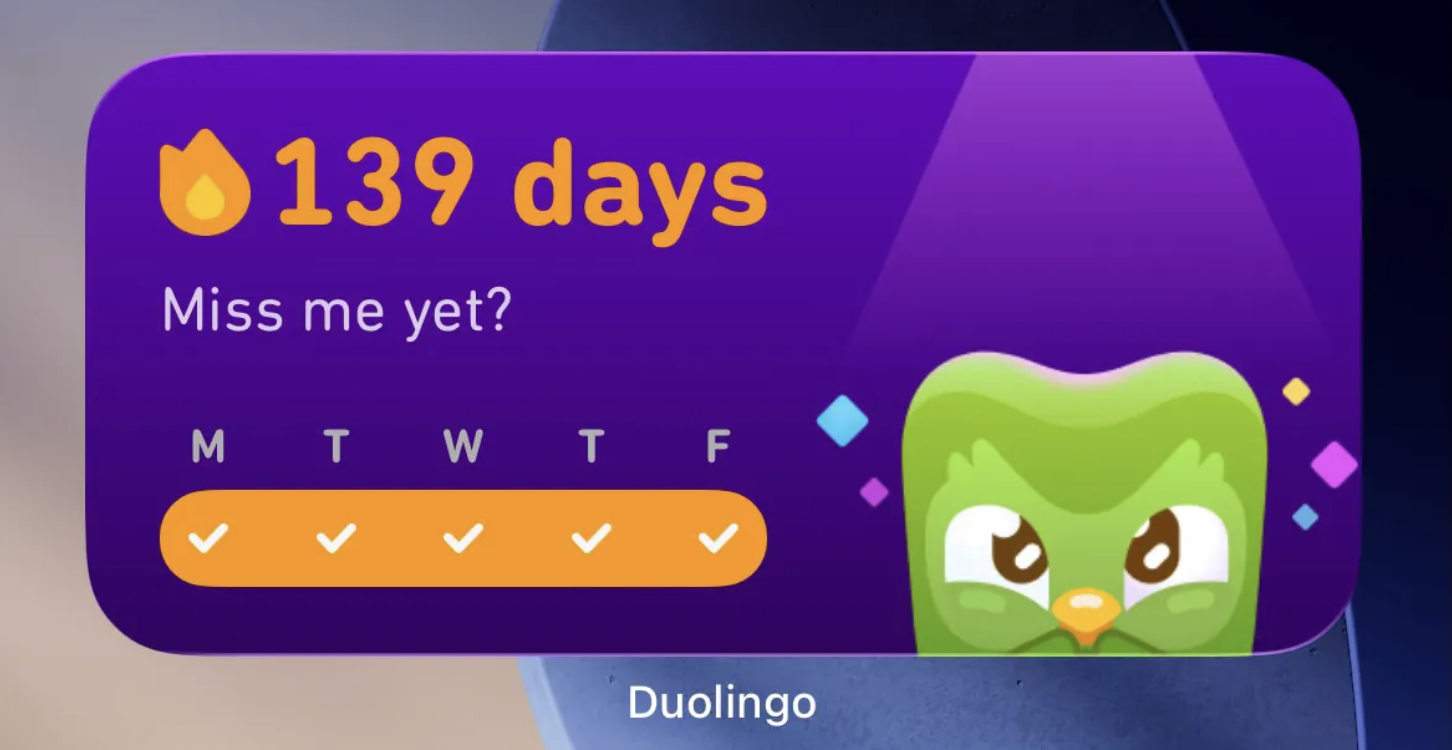
Every glance at that tiny green owl is a reminder of how trivial daily interactions can gradually mount into something significant — and how effortlessly technology engineers habit.
Duolingo has made language learning, traditionally a discipline-heavy and often tedious process, into a daily ritual that millions of people joyfully participate in. But the platform does far more than teach. It generates motivation, fosters a playful brand personality, and discreetly monetises user behaviour. This essay examines Duolingo through three interconnected lenses: behavioural design and habit formation, brand personality and meme culture, and freemium monetisation strategy. Together, these reveal how Duolingo has transformed the digital learning experience — and what that transformation tells us about modern consumer behaviour.
Behavioural Design and the Architecture of Habit
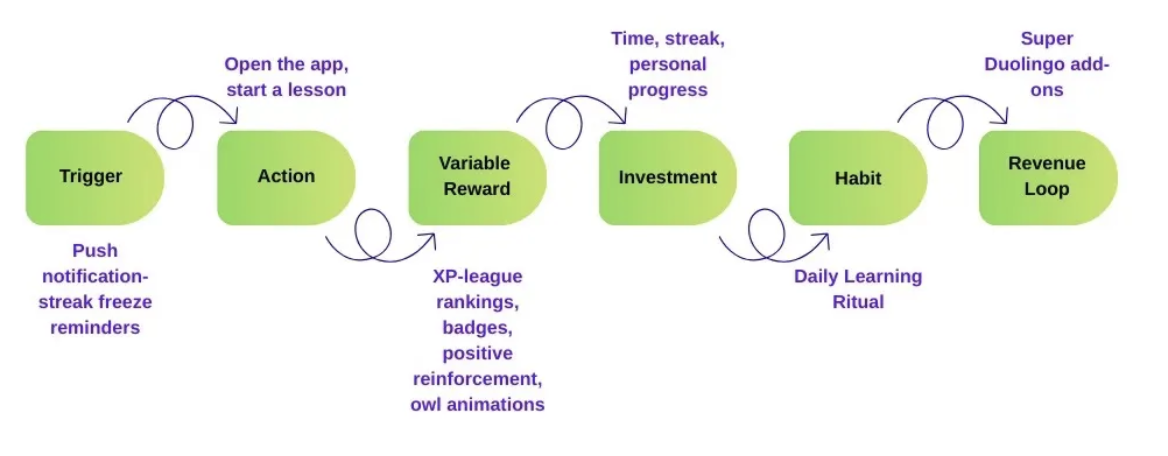
Duolingo's success is founded on its systematic application of behavioural science. The platform uses micro-sized lessons, streak mechanics, and dynamic incentives to construct habit loops that bring users back daily (Bastiaan, Rumokoy, & Tielung, 2024). In doing so, it implements the Fogg Behaviour Model with near-clinical precision: behaviour occurs when motivation, ability, and a trigger converge simultaneously. Lessons are short — keeping cognitive load low. Streaks and rewards raise motivation. Push notifications act as reliable engagement cues.
The goal-gradient effect reinforces engagement further: users increase effort as they approach the completion of a lesson or streak milestone (Kivetz et al., 2006). Combined with loss aversion, streak breaks become psychologically costly events — motivating users to log in even on busy or difficult days (Kahneman & Tversky, 1979). Intermittent reinforcement through XP points and randomised rewards (Skinner, 1953) introduces variability into the experience, a mechanism well established in behavioural psychology for sustaining engagement over time.
Empirical evidence validates these strategies. Rus and Cederberg (2024) found that gamified features in Duolingo produced significantly higher retention rates than non-gamified language applications. Bastiaan et al. (2024) similarly demonstrate how behavioural hooks — hearts, streak freezes, leaderboards — sustain engagement across extended timeframes.
Yet ethical questions remain. While these mechanisms increase engagement, they also risk encouraging compulsive behaviour and prioritising streak maintenance over genuine learning (Mogavi et al., 2022; Chen & Koenig, 2021). The line between motivational nudge and manipulative dark pattern is not always clear — a tension that raises important questions about behavioural ethics in digital learning design.
Brand Personality, Anthropomorphism, and Meme Culture
Duo, Duolingo's green owl, is more than a mascot. Epley, Waytz, and Cacioppo (2007) found that anthropomorphised brands foster trust and emotional attachment in ways that purely functional interfaces cannot. Duo's personality — eccentric, persistent, occasionally guilt-inducing — creates a parasocial relationship with users, making them feel personally responsible for the owl's "emotional state" (Giles, 2002). Missing a lesson stops being a neutral event; it becomes a small act of letting someone down.
Beyond the interface, Duolingo has embedded itself into internet meme culture. Users on TikTok, Instagram, and Reddit joke about Duo haunting them for skipping lessons, making the app a recognisable cultural symbol. This strategic alignment with digital humour does not happen by accident — it amplifies visibility, stimulates emotional engagement, and builds community (Li & Aumeboonsuke, 2025).
Users also integrate Duolingo into their identities. Using the app signals self-improvement, digital fluency, and a particular kind of intellectual curiosity. This is consistent with Bourdieu's (1984) concept of cultural capital — the use of certain platforms becoming a marker of social sophistication and values. Through its brand personality and cultural embedding, Duolingo transcends functionality: it becomes a social artefact, an emblem of modern, playful self-development.
The Freemium Model and Behavioural Monetisation
Beneath the gamified interface and distinctive brand personality is a carefully constructed freemium revenue model. The free tier offers core learning with limited hearts, advertisements, and restricted features. The paid "Super Duolingo" tier removes friction — no ads, unlimited hearts, progress boosters, and premium content. The conversion from free to paid is not driven by content scarcity but by something more behavioural: once users have invested time, formed habits, and developed emotional attachment, the psychological cost of disruption becomes greater than the financial cost of upgrading (Kunkel et al., 2021).
This is behavioural friction theory applied to monetisation. The platform monetises not content but engagement — and the result is a sustainable long-term business model. By 2025, Duolingo had approximately 10.9 million paying users globally, representing a substantial conversion from habitual engagement to revenue (Wikipedia, 2025). The paid tier removes interruptions and expands capability precisely at the moment when users are most psychologically committed to continuing.
Limitations and Ethical Complexity
Duolingo's approach is not without limitations. Research suggests that gamification can sometimes emphasise engagement metrics over educational outcomes — leading users to game the system in order to maintain streaks rather than genuinely absorb language (Shortt et al., 2023). The platform has also been found to be more effective for vocabulary and grammar retention than for developing advanced conversational fluency.
Behavioural pressure can also backfire. For some users, guilt-inducing notifications become a source of stress rather than motivation, ultimately reducing long-term engagement or leading to app deletion (Obie et al., 2020). These dynamics illustrate the fundamental trade-off in persuasive design: between engagement, ethical responsibility, and meaningful outcomes.
Why Duolingo Is Worth Studying
Duolingo is an unusual case study for a specific reason: transparency. The platform periodically publishes data on learning efficacy, conducts A/B testing openly, and shares design thinking — rare behaviour for a large consumer-facing business. This transparency provides researchers with access to real-world behavioural data, making Duolingo an unusually fertile environment for rigorous academic investigation.
Duolingo's convergence of gamification, anthropomorphised brand personality, and global scale creates a rare empirical context in which consumer psychology, behavioural economics, educational theory, and digital marketing all intersect. As a researcher interested in consumer behaviour and digital platforms, Duolingo functions as something close to an interactive laboratory — a place to examine how design shapes identity, engagement, and consumption decisions while also raising substantive ethical questions about persuasive technology.
Its global reach across languages, demographics, and cultures makes it additionally valuable. Analysing Duolingo's impact offers comparative insight into how universal behavioural mechanisms interact with local cultural norms — a research territory that remains relatively underexplored.
Conclusion
Duolingo remains one of the most instructive examples of contemporary digital consumption. Its success in transforming language study into a broadly adopted daily habit demonstrates how behavioural design can lower psychological barriers to sustained engagement. Its brand personality and cultural resonance show how digital platforms integrate into personal identity and social discourse. Its monetisation model reveals both the commercial potential and the ethical complexity of behaviour-driven product design.
As digital products continue to shape not just what we consume but how we think, learn, and construct our daily routines, Duolingo stands as a clear model of consumption as behaviour engineering, identity work, and long-term revenue strategy. For researchers, marketers, and product designers alike, it offers important insights about both opportunity and caution — a reminder that the most effective digital experiences are not just useful, but deeply, deliberately human.
References
- Ainvest. (2025). Duolingo: Multifaceted consumer platform analysis. Ainvest Reports.
- Bastiaan, R. G., Rumokoy, L. J., & Tielung, M. V. J. (2024). What lies beyond streaks and badges? Duolingo's gamification strategy and its limitations. Jurnal EMBA, 12(3), 1275–1288.
- Bourdieu, P. (1984). Distinction: A social critique of the judgement of taste. Harvard University Press.
- Chen, X., & Koenig, V. (2021). Do persuasive designs make smartphones more addictive? arXiv.
- Epley, N., Waytz, A., & Cacioppo, J. T. (2007). On seeing human: A three-factor theory of anthropomorphism. Psychological Review, 114(4), 864–886.
- Fogg, B. J. (2009). A behavior model for persuasive design. Stanford University Persuasive Technology Lab.
- Giles, D. C. (2002). Parasocial interaction: A review of the literature and a model for future research. Media Psychology, 4(3), 279–305.
- Kahneman, D., & Tversky, A. (1979). Prospect theory: An analysis of decision under risk. Econometrica, 47(2), 263–291.
- Kivetz, R., Urminsky, O., & Zheng, Y. (2006). The goal-gradient hypothesis resurrected: Purchase acceleration, illusionary goal progress, and customer retention. Journal of Marketing Research, 43(1), 39–58.
- Kunkel, T., Lock, D., & Doyle, J. (2021). Gamification via mobile applications: Longitudinal effects on loyalty and attitudes toward core service. Psychology & Marketing, 38(9), 1503–1520.
- Li, N., & Aumeboonsuke, V. (2025). How gamification features drive brand loyalty: The mediating roles of consumer experience and brand engagement. Journal of Theoretical and Applied Electronic Commerce Research, 20(2).
- Mogavi, R. H., Guo, B., Zhang, Y., Haq, E.-U., Hui, P., & Ma, X. (2022). When gamification spoils your learning: A qualitative case study of gamification misuse in a language-learning app. arXiv.
- Obie, H. O., Hussain, W., Xia, X., Grundy, J., Li, L., Turhan, B., & Whittle, J. (2020). A first look at human values-violation in app reviews. arXiv.
- Rus, A.-E., & Cederberg, W. (2024). The influence of Duolingo's gamified design elements [Bachelor's thesis, Jönköping University]. DiVA Portal.
- Shortt, M., Lambert, C., & Murphy, V. A. (2023). The real effect of Duolingo: Gamification in mobile-assisted language learning. Evidence, Behaviour & Policy.
- Skinner, B. F. (1953). Science and human behavior. Macmillan.
- Wikipedia. (2025). Duolingo. Retrieved from https://en.wikipedia.org/wiki/Duolingo