
The recent surge in brands using generative AI in consumer-facing communications has transformed the business landscape — and raised a fundamental question: do consumers trust brands that rely on generative AI to communicate with them?
From personalised emails and chatbots to product recommendations and creative content, generative AI systems claim to deliver new levels of efficiency, scale, and personalisation. But trust is the foundation of marketing. A brand is only as strong as its consumers' belief in it. Without trust, even market leaders lose long-term loyalty — and the effects on brand perception can be lasting.
While prior research has examined trust in automation and algorithmic systems, generative AI presents a distinct challenge. Unlike traditional automated systems, generative AI fabricates content that mimics human tone, creativity, and intention. This blurring of human and machine agency challenges how consumers interpret brand objectives, authenticity, and accountability.
This paper presents a conceptual framework for investigating how generative AI shapes consumer trust in marketing contexts. Drawing on trust theory, anthropomorphism research, and perceived control literature, it argues that consumer trust in AI-mediated brand communication is influenced not by AI use itself, but by how AI is disclosed, designed, and experienced.
1. Trust in Marketing
Trust is central to marketing, influencing consumer attitudes, relationship quality, and long-term brand loyalty (Morgan & Hunt, 1994). It becomes especially important in digital and technology-mediated contexts, where uncertainty, information asymmetry, and the absence of interpersonal cues are heightened (Pavlou, 2003). Consumers must rely on brand signals to infer competence, benevolence, and integrity — the core properties that sustain trust (Mayer, Davis, & Schoorman, 1995).
Prior research indicates that trust erodes in conditions where agency and accountability are ambiguous. When consumers are uncertain about who — or what — is responsible for decisions, errors, or outcomes, establishing trust becomes significantly harder (Lankton, McKnight, & Tripp, 2015). This ambiguity is heightened in AI-mediated interactions, where automated systems represent the brand while also operating with varying degrees of autonomy.
Generative AI complicates existing frameworks further. Unlike rule-based systems, it produces fresh, human-like content — challenging foundational assumptions about where brand voice ends and machine output begins. This points to a need to reconsider how trust is established in brand-consumer interactions involving generative AI.
2. Algorithm Aversion and Algorithm Appreciation
Research on algorithmic decision-making reveals a clear tension. Dietvorst, Simmons, and Massey (2015) documented that people often reject algorithmic advice after observing errors — even when the algorithm demonstrably outperforms human judgment. Several mechanisms sustain this aversion: perceived inflexibility, doubts about contextual sensitivity, and the belief that human judgment better captures nuanced values.
Yet the same individuals can display what researchers call algorithm appreciation. Logg, Minson, and Moore (2019) found that people frequently prefer algorithmic over human advice — particularly when an algorithm's performance is visible, or when tasks are perceived as objective. Aversion appears to be context-dependent rather than universal, shaped by how users evaluate algorithmic reliability, relevance, and alignment with human values.
Importantly, most existing research has focused on the outcomes of algorithmic decision-making — accuracy, efficiency, forecast quality — rather than on the experiential and design dimensions of how people interact with algorithms. In marketing environments where communication, persuasion, and relationship-building are central, a performance-only focus is insufficient.
Generative AI systems differ from standard rule-based algorithms because they actively produce content that emulates human language, creativity, and emotional tone. When AI systems are perceived as human-like, consumers tend to apply social heuristics normally reserved for interpersonal interactions — influencing perceptions of warmth, sincerity, and trustworthiness (Waytz, Cacioppo, & Epley, 2010). When AI is opaque or unpredictable, consumers face heightened uncertainty about responsibility and error attribution, weakening trust even in high-performing systems.
3. Anthropomorphism, Transparency, and Perceived Control
Anthropomorphism — the attribution of human-like traits, intentions, or emotions to non-human agents — is critical to how people interpret technology-mediated interactions (Epley, Waytz, & Cacioppo, 2007). In marketing, anthropomorphic cues such as conversational language, emotional expressiveness, and human-like personas have been shown to increase engagement, likability, and perceived warmth (Aggarwal & McGill, 2007).
However, these same signals raise consumer expectations for empathy, moral responsibility, and intentionality — increasing the likelihood of trust violations when those expectations are not met. When non-human agents are perceived as highly human-like, consumers may become uncomfortable or sceptical, particularly in persuasion-sensitive or high-stakes contexts (Kim & McGill, 2011). This tension reflects the dual character of anthropomorphism in AI-mediated brand communication.
Transparency about AI use is a second core design variable. Disclosure of AI involvement can improve perceived honesty by reducing information asymmetry between brands and consumers (Schnackenberg & Tomlinson, 2016). But transparency may simultaneously trigger algorithm aversion — particularly if consumers associate AI with reduced empathy or perceive it as a cost-cutting measure. Transparency may therefore improve perceptions of ethical conduct while decreasing perceived warmth, meaning its effects on trust are conditional rather than universally positive.
Perceived consumer control — the ability to customise outputs, provide feedback, or opt out of AI-generated communication — further modifies consumer responses. Control features can reduce uncertainty and increase psychological safety (Skinner, 1996). Research on technology adoption finds that perceived control strengthens trust by reinforcing a sense of agency and reducing dependence on opaque systems (Lee & See, 2004). In generative AI environments, control may buffer the negative effects of both transparency and anthropomorphism by allowing consumers to adjust their engagement with AI-mediated communication.
4. Conceptual Framework and Propositions
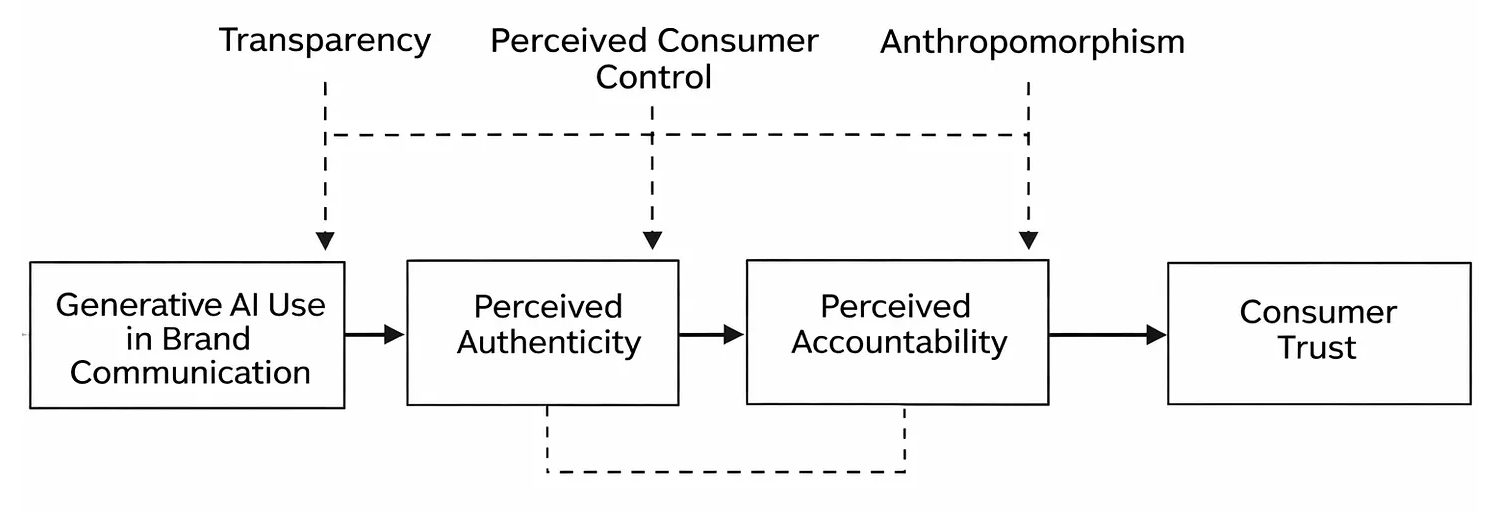
The proposed framework links the use of generative AI in brand communication to consumer trust outcomes via two psychological mechanisms: perceived authenticity and perceived accountability. Transparency, perceived consumer control, and anthropomorphism function as moderating design elements that shape these mechanisms.
4.1 Core Mechanism: Authenticity and Accountability
The framework holds that generative AI reshapes trust not through raw performance but through how consumers assess authenticity and accountability. When AI-generated messages obscure the source of agency, the brand's voice appears less genuine and the connection between intent and outcome becomes ambiguous — producing a trust deficit even when the content itself is factually accurate.
This mirrors findings on algorithm aversion: users reject advice when they perceive a system as inflexible or when its role is obscured. Conversely, when AI's contribution is made transparent and framed as a tool augmenting human judgment, perceptions of credibility improve — reflecting the algorithm appreciation effect observed when performance is highlighted and tasks are perceived as objective. Signalling clearly who is responsible for generated content allows consumers to map accountability, reducing uncertainty and restoring perceived sincerity.
4.2 Transparency as a Trust Signal
Disclosure of AI involvement can improve perceived brand integrity by reducing knowledge asymmetry. But transparency may simultaneously trigger scepticism by emphasising the non-human origin of communication — decreasing perceived warmth or emotional authenticity. Transparency is therefore expected to exert a dual effect on trust, operating through opposing psychological pathways tied to integrity and relational closeness.
Proposition 1 (P1). Transparency about the use of generative AI in brand communication increases perceived brand integrity while decreasing perceived warmth, resulting in a conditional effect on consumer trust.
4.3 Perceived Consumer Control
Perceived control is predicted to attenuate consumer reactions to AI-mediated brand communication by reducing uncertainty and psychological dependence on automated systems. When consumers have meaningful influence over AI-generated content — opportunities to customise it, provide feedback, or opt out — they are more likely to view AI as a helpful tool rather than an autonomous decision-maker. Perceived control may therefore buffer the negative trust effects of both transparency and anthropomorphism.
Proposition 2 (P2). Perceived consumer control mitigates the negative impact of generative AI on consumer trust by reducing uncertainty and promoting a sense of agency.
4.4 Anthropomorphism and Social Heuristics
Anthropomorphic design elements encourage consumers to apply interpersonal heuristics in AI-mediated brand communication. Human-like language, emotional tone, and conversational dynamics can increase engagement and perceived warmth, building trust in low-stakes or relational contexts. However, anthropomorphism may simultaneously raise expectations for empathy and moral responsibility, increasing the risk of trust erosion when AI-generated communication is perceived as deceptive, inaccurate, or misaligned with consumer values.
Proposition 3 (P3). Anthropomorphic AI-generated brand communication increases perceived warmth and engagement while decreasing consumer trust in high-stakes or persuasion-sensitive contexts.
4.5 The Integrated Picture
Taken together, the framework suggests that consumer trust in AI-mediated brand communication is shaped not by AI use itself, but by how AI is disclosed, designed, and experienced. Transparency, perceived control, and anthropomorphism interact to influence perceptions of authenticity, accountability, and warmth — ultimately determining trust outcomes. This integrative perspective moves beyond binary accounts of algorithm aversion or appreciation, emphasising the role of deliberate design decisions in responsible, trust-sensitive AI marketing.
5. Directions for Future Research
Future work can empirically test this framework through experimental designs that manipulate transparency, anthropomorphism, and perceived consumer control in AI-mediated brand communication, examining how these variables influence perceived authenticity, accountability, and trust.
Research should also investigate boundary conditions — particularly how trust dynamics differ between high-stakes contexts (healthcare, finance, legal) and low-stakes or hedonic consumption situations, where anthropomorphic AI may be received more positively. Cross-cultural studies are a further important extension, as cultural orientations toward uncertainty, automation, and authority may significantly shape how consumers respond to generative AI in brand communication.
Qualitative and longitudinal approaches would add depth to quantitative studies, helping illuminate how consumers attribute responsibility for AI-generated content over time — and how trust in AI-mediated brand interactions develops, erodes, or recovers across extended relationships.
Conclusion
The question of whether consumers trust brands that use generative AI does not have a simple answer. Trust is not determined by whether AI is used, but by how it is used — how it is disclosed, how much control consumers feel they have, and how human-like it appears.
Brands that treat AI transparency, consumer control, and anthropomorphic design as purely technical decisions miss the deeper psychological mechanisms at work. Each of these design choices shapes whether a consumer perceives the brand as sincere, accountable, and human — and whether, in a world where the brand's voice is increasingly generated rather than written, trust can still be built and sustained.
References
- Aggarwal, P., & McGill, A. L. (2007). Is that car smiling at me? Schema congruity as a basis for evaluating anthropomorphized products. Journal of Consumer Research, 34(4), 468–479.
- Dietvorst, B. J., Simmons, J. P., & Massey, C. (2015). Algorithm aversion: People erroneously avoid algorithms after seeing them err. Journal of Experimental Psychology: General, 144(1), 114–126.
- Epley, N., Waytz, A., & Cacioppo, J. T. (2007). On seeing human: A three-factor theory of anthropomorphism. Psychological Review, 114(4), 864–886.
- Kim, S., & McGill, A. L. (2011). Gaming with Mr. Slot or gaming the slot machine? Power, anthropomorphism, and risk perception. Journal of Consumer Research, 38(1), 94–107.
- Lankton, N. K., McKnight, D. H., & Tripp, J. F. (2015). Technology, humanness, and trust: Rethinking trust in technology. Journal of the Association for Information Systems, 16(10), 880–918.
- Lee, J. D., & See, K. A. (2004). Trust in automation: Designing for appropriate reliance. Human Factors, 46(1), 50–80.
- Logg, J. M., Minson, J. A., & Moore, D. A. (2019). Algorithm appreciation: People prefer algorithmic to human judgment. Organizational Behavior and Human Decision Processes, 151, 90–103.
- Mayer, R. C., Davis, J. H., & Schoorman, F. D. (1995). An integrative model of organizational trust. Academy of Management Review, 20(3), 709–734.
- Morgan, R. M., & Hunt, S. D. (1994). The commitment–trust theory of relationship marketing. Journal of Marketing, 58(3), 20–38.
- Pavlou, P. A. (2003). Consumer acceptance of electronic commerce: Integrating trust and risk with the technology acceptance model. International Journal of Electronic Commerce, 7(3), 101–134.
- Schnackenberg, A. K., & Tomlinson, E. C. (2016). Organizational transparency: A new perspective on managing trust in organization–stakeholder relationships. Journal of Management, 42(7), 1784–1810.
- Skinner, E. A. (1996). A guide to constructs of control. Journal of Personality and Social Psychology, 71(3), 549–570.
- Waytz, A., Cacioppo, J. T., & Epley, N. (2010). Who sees human? The stability and importance of individual differences in anthropomorphism. Perspectives on Psychological Science, 5(3), 219–232.